From the field
The fire season, explained
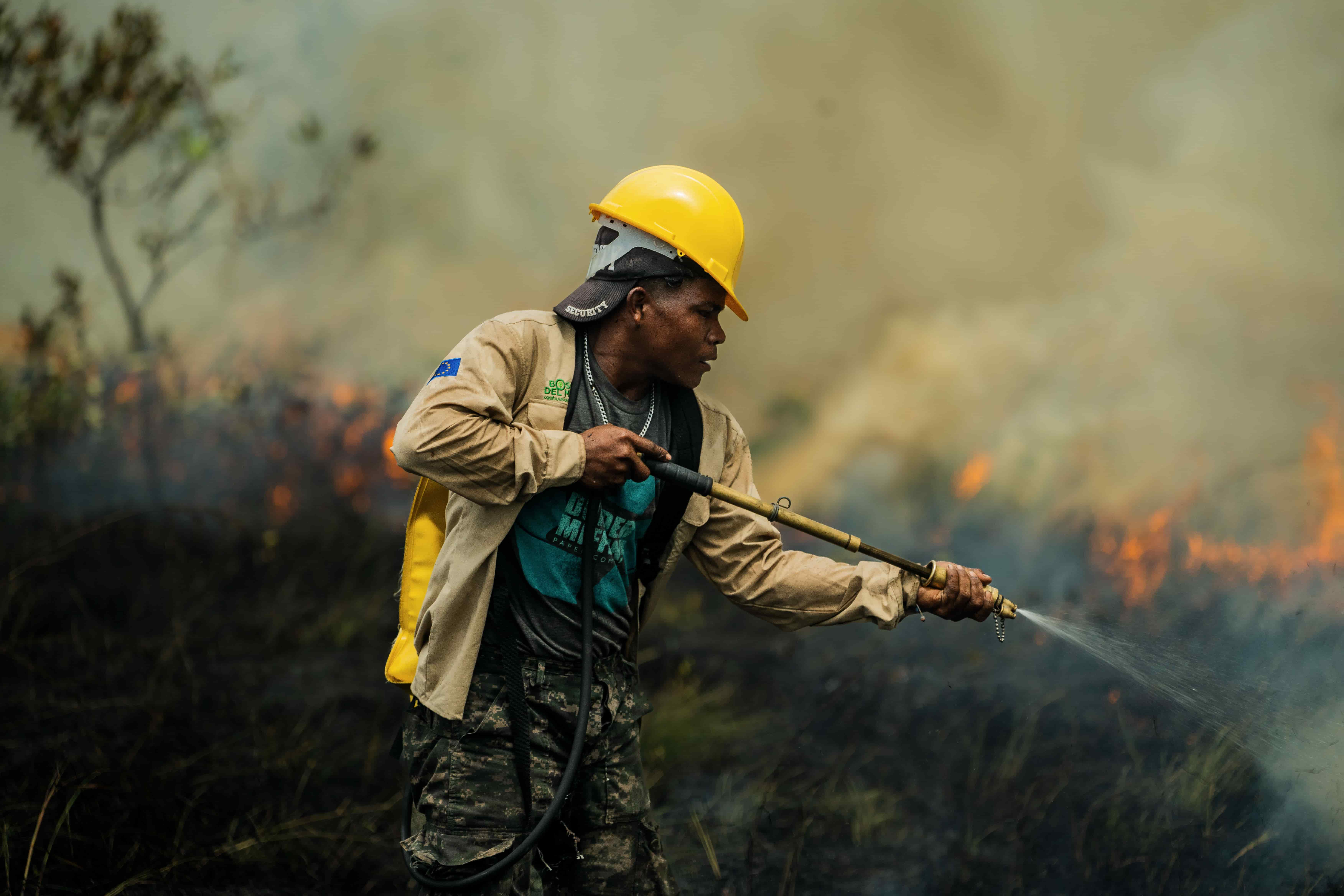
Every dry season, fire moves across the pine savanna of La Mosquitia. To understand the work here, it helps to understand where those fires come from.
Almost all of them are lit by people, and most start close to the roads and tracks where people travel. A cooking fire, a cigarette, children playing. During filming we met a group of children who had set the ground alight to drive out a snake. Nobody meant any harm. In the dry season it takes very little, and a single fire can cross a large stretch of land in no time.
Why the forest cannot return on its own
The big Caribbean pines survive these fires. The young trees do not. When the same ground burns year after year, every new generation of seedlings is killed, and the land stays open savanna even though the seed is already there. It takes years before a tree is tall enough to live through a fire.
Firebreaks, then a brigade
The first step is a cleared strip of ground that fire cannot cross. The firebreaks surround the protected area and also run through it.
At four meters, a fire jumps it. It is too small.
Octavio Paulino, fire brigade
A firebreak alone is not enough, because a fire that starts inside still has to be put out. So the community formed a brigade, and the places on it rotate so that the work reaches as many families as possible.
We have four watchmen, one in each direction. When a fire breaks out, they alert the brigade.
Octavio Paulino, fire brigade
There is rarely water nearby. The brigade beats out the flames with rubber mats, and when the fire reaches too high, there is nothing to do but stand back and wait for it to drop.
Fire against fire
The brigades also use fire deliberately. Burning the ground themselves before the dry season, under control, removes the fuel that a wildfire would need later.
Since we did not have firebreaks built here before, this year we took the initiative to do a controlled burn, to prevent the fires.
Maklin, Paskaia field team
Fire is also part of how this forest reproduces. The heat opens the cones of the Caribbean pine, and the seed falls on ground that has just been cleared.
Fire has a good side and a bad side. The pine ecosystem depends on fire. That same heat opens the cones so they can scatter their seeds, and that is how the forest comes back.
Isuara, GIS and monitoring, Paskaia
This is why the project plants very little. Where mature pines are still standing, they seed the ground themselves. What the trees need is not to be planted but to be left alone long enough to grow. Where natural regeneration is too thin, planting is added to help it along.
The fire season still comes every year. What changes is what it leaves behind.
The quotes in this article are from interviews filmed in La Mosquitia, translated from Miskito and Spanish.